

India’s flexible workspace market grew from 2.2 million sq. ft. of transactions in 2017 to 18.6 million sq. ft. in 2025, an 8× increase in eight years. As more businesses move away from traditional leases, the shared office space vs coworking space debate has become one of the most common decisions growing teams face today.
You’re either paying for office space you don’t fully use or working in a setup that lacks the privacy and flexibility your team needs. Either way, it’s a sign that your current workspace may not be the right fit.
Businesses today have more workspace options than ever before. The challenge is choosing the one that best suits your needs. This is where understanding the differences between a shared office space and a coworking space becomes essential.
TL;DR: Shared office spaces give businesses a private, branded environment under a flexible lease, ideal for teams that need consistency. Coworking spaces offer more flexibility and community but less privacy. Choosing between the two comes down to your team size, budget, and how much control over your workspace environment actually matters to your bottom line.
Table of Contents
|
What Is a Shared Office Space
A shared office space is a privately managed facility where multiple businesses rent individual, dedicated areas within the same building. Instead of leasing a whole office floor, you rent a managed office space for your team. Services like reception, maintenance, security, and utilities are shared, which helps to reduce overall costs.
You get a private office with your own branding and a dedicated environment where your team can work together without constant distractions from other businesses.
Key Features of a Shared Office Space
- Dedicated, lockable workspace: Your team’s area isn’t shared with other companies
- Flexible lease terms: Typically month-to-month or short-term, unlike 3–5 year traditional leases
- Shared amenities: Common areas, meeting rooms, and reception are shared but professionally managed
- Branding opportunity: Many providers allow signage, giving your business a visible identity at the door
- Managed operations: Cleaning, utilities, and maintenance are included in the rent
Businesses That Benefit Most from Shared Office Space
Shared office spaces are particularly suitable for:
- Legal firms and consultants require private meeting spaces for confidential client discussions.
- Financial services companies handling sensitive financial information and compliance-related work.
- Healthcare and medical consulting firms that need secure environments for client and patient-related data.
- Professional services businesses with frequent client meetings that benefit from a branded and professional office setting.
- Growing startups and SMEs that have outgrown coworking spaces and need dedicated workspace for their teams.
What Is a Coworking Space?
A coworking space is an open, membership-based facility where individuals and teams from different companies work alongside one another. You pay for access, a desk, a booth, or sometimes a small private office, rather than leasing a defined area.
Coworking spaces encourage interaction and collaboration. The main appeal lies in its simplicity; you can move in quickly, set up your laptop, and start working right away.
Key Features of a Coworking Space
- Flexible membership plans with daily, weekly, monthly, or long-term options.
- Shared work environments where professionals from different companies work alongside each other.
- Hot desks and dedicated desks that allow users to choose the level of workspace commitment they need.
- Access to private offices and meeting rooms on a booking basis for focused work and client meetings.
- Fully managed facilities including internet, utilities, maintenance, and office support services.
- Scalable workspace options that make it easy to add or reduce seats as business needs change.
Who Can Use Coworking Spaces
- Remote workers are looking for a professional environment outside their homes.
- Independent professionals who need flexible workspace without long-term commitments.
- Startups looking for affordable office solutions and networking opportunities.
- Small teams and growing businesses that require workspace flexibility as headcount changes.
- Consultants and business travelers who frequently work across multiple cities.
- Satellite teams of larger enterprises are looking for flexible regional office space.
- Entrepreneurs and solopreneurs who benefit from community interaction and collaboration opportunities.
Key Differences Between Shared Office Space vs Coworking Space
While both options offer flexibility compared to traditional office leases, they differ significantly in terms of privacy, cost, scalability, and the overall work environment.
| Factor | Shared Office Space | Coworking Space |
| Privacy | High, dedicated, enclosed area for your team only | Low to moderate, open floor or bookable booths |
| Flexibility | Flexible than traditional offices, but less flexible than coworking spaces | Highest, daily, weekly, or monthly memberships |
| Branding | Strong signage and a dedicated entry are possible | Minimal, you’re one of many tenants |
| Networking | Limited to building tenants | Active community, curated events, cross-industry exposure |
| Cost | Higher monthly fee, but includes private space | Lower entry cost; scales with usage |
| Scalability | Requires renegotiation as the team grows | Add or remove memberships easily |
| Meeting rooms | Often included or at a low add-on cost | Usually credit- or hour-based charges |
| Best for | Teams of 5–50 needing a consistent, private workspace | Solos, small teams, or remote-first companies |
The right choice depends on your team’s priorities. If privacy and a dedicated workspace matter most, a shared office space may be the better fit. If flexibility, networking, and lower upfront costs are your priorities, a coworking space could be the ideal solution.
Suggested Reading: Difference Between Traditional Offices and Managed Offices
Shared Office Space vs Coworking Space: Cost Comparison for Office Space for Rent
The cost of a workspace depends on various factors.
- Location: City center and high-demand zones cost more than suburban areas. For instance, office space in HSR Layout in Bangalore will cost higher than Whitefield or Hebbal.
- Team size: Per-seat costs drop with scale in shared offices
- Membership type: Hot desk costs lower than dedicated desk, or private office
- Contract length: Month-to-month costs more per month than quarterly costs
- Included services: Meeting room, conference rooms parking, IT supports adds to the prices
Average Monthly Costs of Office Space (India, 2026)
| Workspace Type | Average Monthly Cost | Suitable for |
| Hot desk (coworking) | ₹5,000 – ₹12,000/seat | Solo professionals, 1–3 days/week use |
| Dedicated desk (coworking) | ₹10,000 – ₹20,000/seat | Full-time remote workers, small teams |
| Private office (coworking) | ₹25,000 – ₹80,000/cabin | Teams of 2–6 needing privacy in a flex hub |
| Shared office space (managed) | ₹15,000 – ₹35,000/seat | Teams of 8+ with regular client visits |
| Traditional office lease | ₹40,000 – ₹1,20,000+/month | Large, stable teams with slong-term plan |
Shared Office Space vs Coworking Space: Which Flexible Workspace Solution Fits Your Business?
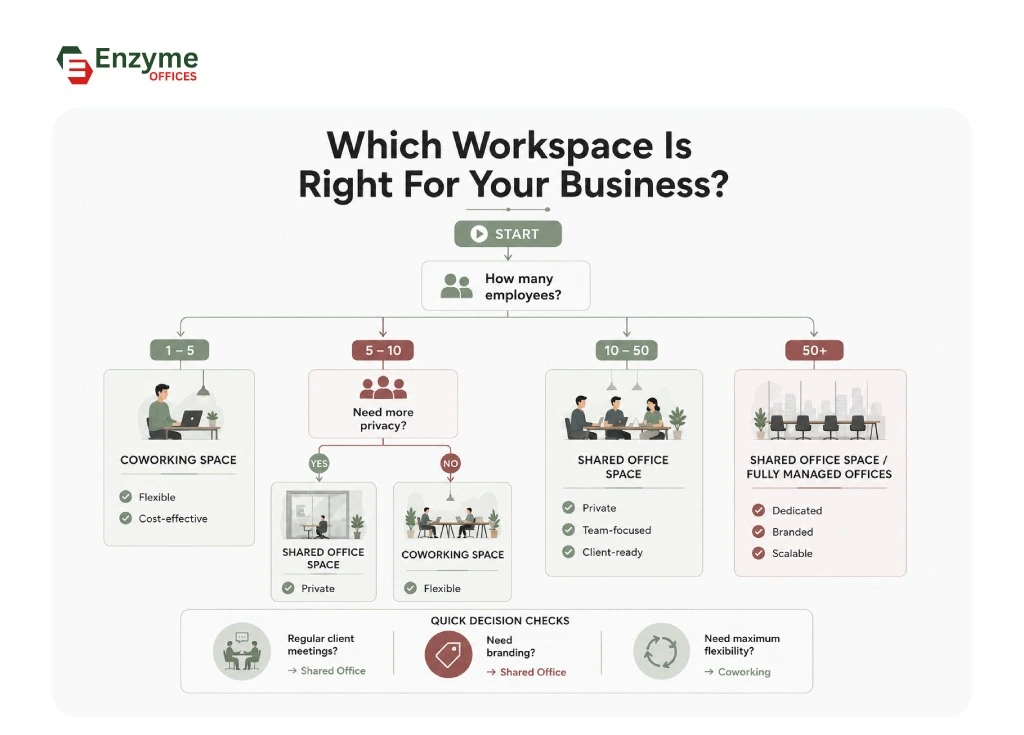
Selecting the right workspace depends on your team size, work style, growth plans, and need for privacy. Here’s how different types of businesses can explore their options.
1. Startups and Early-Stage Companies
For startups, speed and cost flexibility are often the top priorities. Coworking spaces provide a ready-to-use environment without the commitment and upfront costs of a traditional office.
- Immediate access to workspace and amenities
- No fit-out or infrastructure investment
- Opportunities to network with other businesses
- Flexible plans that support changing team sizes
2. Small and Medium-Sized Businesses
As teams grow, privacy and consistency become more important. Shared office spaces provide a professional environment without the long-term commitment of a conventional lease.
- Greater privacy for client and team discussions
- Professional business address
- Dedicated space for growing teams
- Managed services without landlord responsibilities
3. Remote and Hybrid Teams
For remote and hybrid teams, the best choice depends on how frequently employees work together in person and whether they need access to multiple locations.
- Coworking spaces support distributed teams
- They can access to multiple locations through provider networks
- Shared offices is the best for teams with a central workplace
4. Growing Enterprises
Managed shared office spaces allow growing businesses to expand into new markets while minimizing operational complexity and financial risk.
- Lower upfront investment than traditional offices
- Faster market expansion without long leases
- Managed operations reduces administrative burden
5. Independent Professionals
Freelancers and consultants need a professional workspace without paying for more space than they use. A coworking space is the best for them.
Conclusion
Selecting between office space vs coworking space depends on how your team actually works. Coworking spaces are ideal for freelancers, startups, and businesses that want flexibility and networking. Shared office spaces are suitable for growing teams dedicated work areas, and a professional environment without the commitment of a traditional lease.
Enzyme Offices provides fully managed, move-in-ready workspaces for growing teams of 50 across Bangalore, Mumbai, Pune, Hyderabad, and Delhi-NCR.
Its competitive pricing, flexible rental and low upfront cost and 24/7 makes it a preferred choice for businesses like Vyapar, Paytm, Robosoft and Medlife. Contact us to get a customized quote for your office needs.