

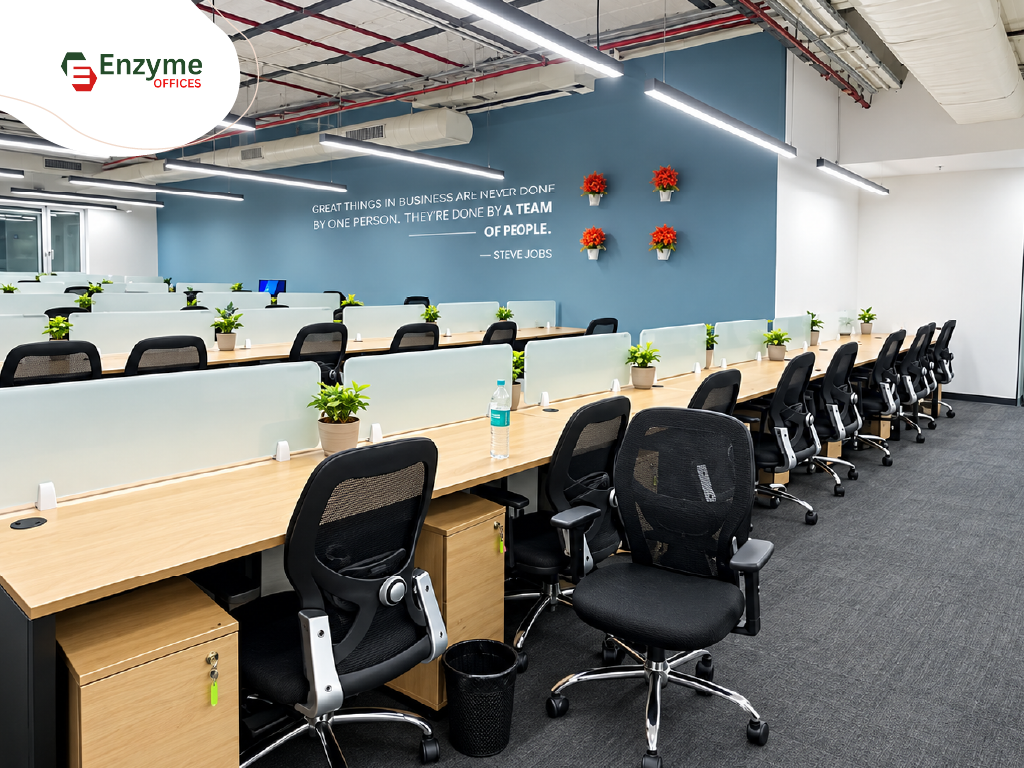
You’ve found an office that fits your team and budget. Before signing the lease, check whether the space supports how your team works.
A bare-shell office may give you complete control but leave you responsible for everything from fit-outs to IT setup. A managed office removes most setup work, while a shared office provides ready-to-use infrastructure under a shorter commitment.
The wrong types of office spaces can mean higher costs, delayed move-in, or a workspace that becomes difficult to scale. Pune’s Q1 2026 leasing figures show how quickly flexible workspace demand has grown.
Pune’s flex segment accounted for 54.8% of the city’s office leasing volume in Q1 2026, surpassing every other occupier segment for the first time.
This guide compares each model by cost, control, setup, flexibility, and business fit.
|
TL;DR
|
|
Table of Contents
|
What are the main different types of office spaces
Bare-shell, managed, and shared offices differ mainly in setup responsibility, operational support, privacy, and flexibility. Bare-shell offices provide control, managed office spaces balance privacy with provider support, and shared offices require the least setup.
| Office type | Basic model | Setup responsibility | General business fit |
| Bare shell | Unfitted leased space | Tenant | Established businesses seeking control |
| Managed | Private, fitted and provider-operated | Workspace provider | Growing teams and enterprises |
| Shared | Facilities shared by several users | Workspace provider | Freelancers, startups and small teams |
What is a bare-shell office?
A bare-shell office is leased in a basic structural condition. It has a finished floor slab, ceiling, and outer walls, along with utility connection points, but no usable workplace infrastructure.
A warm-shell office typically includes basic flooring, a finished ceiling, and preliminary electrical work. Handover specifications vary, so tenants should obtain a written list before comparing quotes.
Usually excluded from a bare-shell handover:
- Flooring and false ceiling
- Interior partitions and cabins
- Furniture and workstations
- Internet cabling and network points
- Meeting rooms
- Branding and signage
The tenant usually manages:
- Interior design and fit-out execution
- Vendor selection and contracts
- Furniture and equipment procurement
- Internet and IT installation
- Security and access-control systems
- Maintenance and housekeeping
- Main advantages: High layout control, extensive branding options, and a dedicated environment built around the company’s processes.
- Main limitations: High initial investment, a longer setup period, vendor coordination, and greater exposure to the cost of future changes.
For a 250-person financial services company planning a long-term stay, controlled access, private client areas, and a custom layout can justify the fit-out investment.
A 30-person startup expecting rapid growth faces greater risk because its space requirements could change before recovering that investment.
What is a managed office space?
A managed office is a private, fitted workspace operated by one provider on the tenant’s behalf. The business avoids coordinating separate contractors for furniture, internet, utilities, housekeeping, and security.
Unlike a shared office, the workspace is dedicated to one company. Tenants can negotiate branding and layout changes within the contract scope.
Services commonly included:
- Furniture and an agreed layout
- Internet and IT infrastructure
- Utilities and power backup
- Reception and access management
- Housekeeping, security and maintenance
- Meeting rooms and common areas
- Main advantages: Faster occupancy, lower initial setup responsibility, consolidated monthly billing and the possibility of changing capacity under the contract.
- Main limitations: A higher monthly cost than a bare-shell rent quote, limits on customization, and dependence on the provider’s service standards.
Consider a software company opening a 50-person office space in Pune. A managed office reduces setup work by giving the operations lead a single provider for setup and facilities. The company can focus on hiring and onboarding instead of managing contractors in a new city.
Growing companies, project teams, regional offices, and new GCC operations are strong candidates for managed space.
What is included in a managed office?
The monthly fee commonly covers:
- Furniture
- Internet and IT setup
- Utilities
- Housekeeping
- Security
- Reception support
- Meeting-room access
What is a shared or coworking office?
A shared office or coworking space accommodates people from different organisations in one facility. Coworking is a form of shared office, but the two labels do not always describe the same setup.
Shared facilities range from open-desk setups to coworking centres with private cabins and team rooms.
Common workspace formats:
- Hot desks
- Dedicated desks
- Private cabins
- Team rooms
Shared facilities commonly include:
- Reception
- Meeting rooms
- Pantry and breakout areas
- Internet and utilities
- Main advantages: Quick occupancy, low setup responsibility, shorter commitments in many contracts and access to common facilities.
- Main limitations: Less privacy, limited branding, possible noise or room-availability constraints and restrictions on network or security changes.
Shared space works well for freelancers, remote employees, startups, small businesses and temporary project teams.
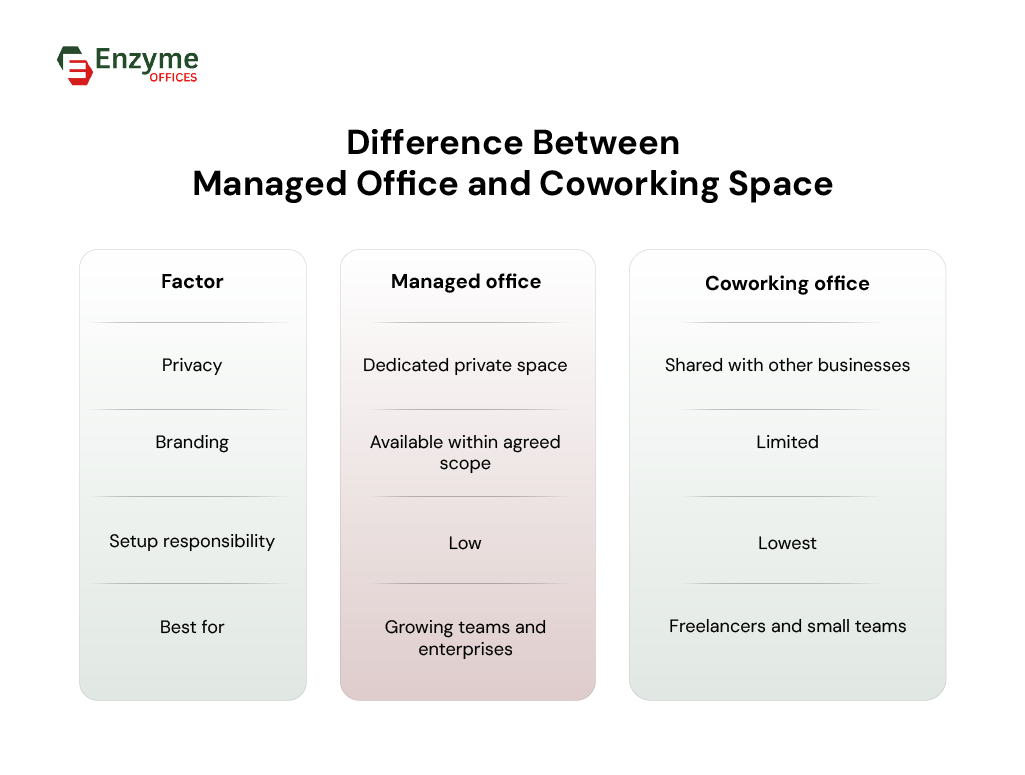
Bare shell vs. managed vs. shared office space
Use bare shell for long-term control, managed space for a private ready-to-use office, and shared space for short-term flexibility. The right option depends on your budget, occupancy period and expected headcount.
| Decision factor | Bare shell | Managed office | Shared office |
| Move-in time | Longest | Short | Shortest |
| Initial investment | High | Low to moderate | Low |
| Furniture | Tenant arranges | Usually included | Included |
| Internet and IT | Tenant arranges | Usually provider-managed | Shared or plan-based |
| Maintenance | Tenant | Provider | Provider |
| Utilities | Tenant manages | Commonly consolidated | Commonly included |
| Layout control | High | Moderate to high | Low |
| Branding | High | Available within scope | Limited |
| Privacy | High | High | Low to moderate |
| Contract flexibility | Usually lower | Moderate | High |
| Seat scalability | Requires planning | Easier, subject to availability | Usually easiest |
| Operational workload | High | Low | Low |
| Best fit | Stable, established teams | Growing or enterprise teams | Individuals and smaller teams |
Inclusions and terms vary by contract. Compare total occupancy cost over the expected term, not only the rent per seat. Bare-shell space may be economical for a stable long-term team, while managed space may reduce the cost and risk of near-term expansion or downsizing.
What does each office model really cost?
Bare-shell offices require higher upfront investment, while managed and shared offices shift most setup costs into a recurring fee. Compare the total cost per occupied seat across your expected term, not only the quoted rent.
Initial costs
- Security deposit
- Brokerage or transaction charges
- Design and fit-out
- Furniture
- IT and network setup
- Access and security systems
- Legal and administrative charges
- Relocation costs
Recurring costs
- Rent or membership fee
- Utilities and internet
- Maintenance and repairs
- Security and housekeeping
- Facilities staff
- Meeting-room or printing charges
Overlooked costs
- Fit-out delays that postpone occupancy
- Reinstatement obligations at the end of the lease
- Paid but unused seats
- Future expansion or relocation
- Internal time spent coordinating vendors
- Mid-term service upgrades
- Parking and after-hours access
A practical comparison method
Use the following formula to compare each option:
| Total occupancy cost = initial costs + recurring costs + operating costs + change or exit costs |
Divide the total by the expected occupancy period and average number of occupied seats. The result is a per-seat, per-month figure based on comparable cost categories.
Run two additional scenarios, one below and one above the expected headcount. This shows whether a low initial quote becomes expensive when seats remain unused or when the team needs more space.
Which office space fits your business?
Shared space works for small or temporary teams. Managed space supports growing companies and new-city operations. Bare shell fits stable businesses that need extensive control. Evaluate each option against projected headcount, privacy requirements, and the planned occupancy period.
Match the office type to your business stage
| Business situation | Likely starting point | Reason |
| Freelancer or remote employee | Shared or coworking | Low commitment and ready infrastructure |
| Early-stage startup | Shared office | Easy entry and seat flexibility |
| Small team needing privacy | Private unit in a shared facility | Dedicated room with shared services |
| Growing company | Managed office | Private space with lower operating burden |
| Enterprise entering a new city | Managed office | Faster launch and one service contact |
| Stable enterprise headquarters | Bare shell or managed | Depends on control, term, and capital |
| Short-term project team | Shared or managed | Faster setup for a defined term |
| Hybrid workforce | Shared or managed | Capacity can reflect attendance patterns |
If your priority is:
- Maximum design control: Bare shell
- Fastest basic move-in: Shared office
- Private space without facilities management: Managed office
- Lowest initial setup responsibility: Shared or managed office
- Strong branding with operational support: Managed office
- Long-term control for stable occupancy: Bare shell
- Simpler seat expansion: Managed or shared office, subject to availability
Stable teams can spread a fit-out investment across a longer period. Teams with uncertain hiring plans need contracts that limit the financial impact of expansion, downsizing, or relocation.
What should you check before shortlisting an office space in Bangalore?
Check the total monthly cost, included services, commute options, power backup, internet, access hours, expansion terms, and exit conditions. Assess every shortlisted property against the same checklist to make a fair comparison.
An office space in Bangalore should be assessed against business, contract, building and employee requirements. Use the same checklist for every property so attractive interiors do not distract from operating constraints or hidden charges.
Business requirements
- Current and expected headcount
- Daily attendance under the hybrid policy
- Desired move-in date
- Expected occupancy period
- Privacy and compliance requirements
- Dedicated network or server needs
- Branding and layout requirements
Contract and cost questions
- What does the monthly quote include?
- Which services cost extra?
- Can seat capacity be changed?
- What are the deposit and notice requirements?
- How do escalation clauses work?
- Who pays for repairs and replacements?
- Do reinstatement charges apply?
- What happens if the business exits early?
Building and employee factors
- Public transport and road access
- Parking availability and cost
- Power backup
- Security and access hours
- Meeting-room availability
- Air-conditioning hours
- Nearby food and essential services
- Accessibility requirements
During a site visit, ask the provider to demonstrate the internet connection, access controls, power backup, and meeting-room booking process. A procurement manager should also request a sample invoice and contract schedule. These checks reveal operational gaps that are easy to miss during a visual tour.

Final takeaway
A bare-shell office suits businesses that need more control and can manage fit-out, vendors, and a longer commitment. A managed office is ideal for teams that need privacy and customization without taking on daily facilities work while a shared office suits businesses that want a ready-to-use quickly without setup costs and enjoy more flexibility to add seats.
Businesses comparing office space in Pune with Bangalore locations should consider headcounts, occupancy period and overall cost before choosing one. Enzyme Offices offers managed offices for 50+ teams across both cities.
Get in touch with us to discuss your office requirements and schedule a site visit.