


Bengaluru and Pune together accounted for 49% of India’s office demand in the first half of 2026, according to the CREDAI-CRE Matrix Q2 CY’26 report. Pune’s rents are lower, while Bangalore’s talent pool is bigger. Bengaluru has the lowest vacancy in the country at 9.6%; Pune’s vacancy is 18.7%, which can mean more choice and more room to negotiate.
However, rent alone does not determine which city offers better value. Hiring costs, employee commutes, fit-out, parking, lease terms, and the flexibility to add space can all affect the total cost of setting up and running an office.
Additionally, costs also vary significantly between business hubs within the same city. In Pune, Baner and Hinjewadi serve different business needs, just as Whitefield and Electronic City offer different advantages in Bangalore.
If you’re comparing Pune office space with Bangalore, this guide covers office costs, business hubs, talent availability, connectivity, workspace flexibility, and expansion options to help you choose the right location.
TL;DR
If office cost is the priority, Pune is the better place to start your search. If your primary goal is to hire highly specialized software engineers, AI specialists, or product developers, or if being close to investors and top tech startups is essential, Bangalore is worth the extra cost. For either city, compare the specific micro-market and total occupancy cost before signing a lease.
Table of contents
|
Pune vs Bangalore office space: Quick comparison
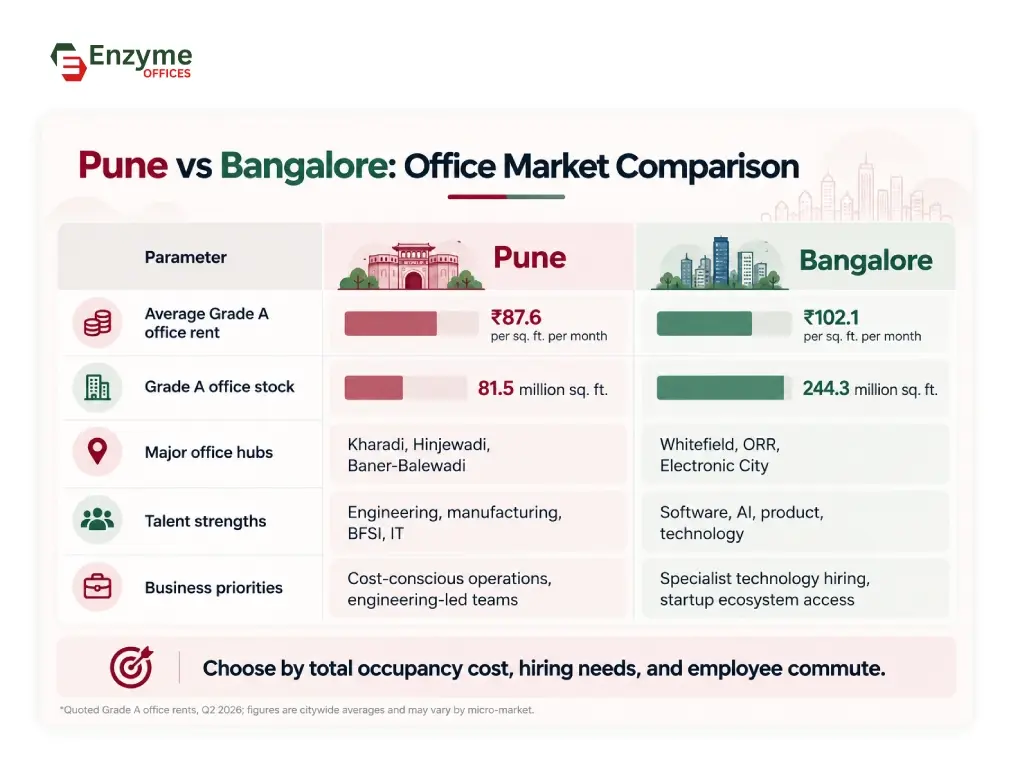
Pune and Bangalore office spaces differ in average rent, office supply, talent concentration, business hubs, and workspace options. The table below provides a city-level comparison before you look at individual micro-markets.
| Factor | Pune | Bangalore |
| Office market | Large Grade A office market with established IT, GCC and engineering clusters | India’s largest Grade A office market, with extensive technology and GCC clusters |
| Q2 2026 average quoted rent | ₹87.6/sq. ft./month | ₹102.1/sq. ft./month |
| Major office hubs | Kharadi, Baner-Balewadi, Hinjewadi, Viman Nagar, Hadapsar | Whitefield, ORR, Electronic City, HSR Layout, North Bangalore |
| Key talent strengths | Engineering, technology, automotive, manufacturing, BFSI and GCCs | Technology, software, AI, product, engineering and GCCs |
| Office market demand | Technology, GCC, engineering and manufacturing demand | Large technology, GCC, BFSI and flex-space demand |
| Flex-space market | Growing market | Larger and more mature |
| Best suited for | Cost-conscious teams, engineering-led businesses, GCCs and growing companies | Technology companies, large enterprises, specialist hiring and companies seeking a deep technology ecosystem |
Pune vs Bangalore: Which city offers the better business advantage?
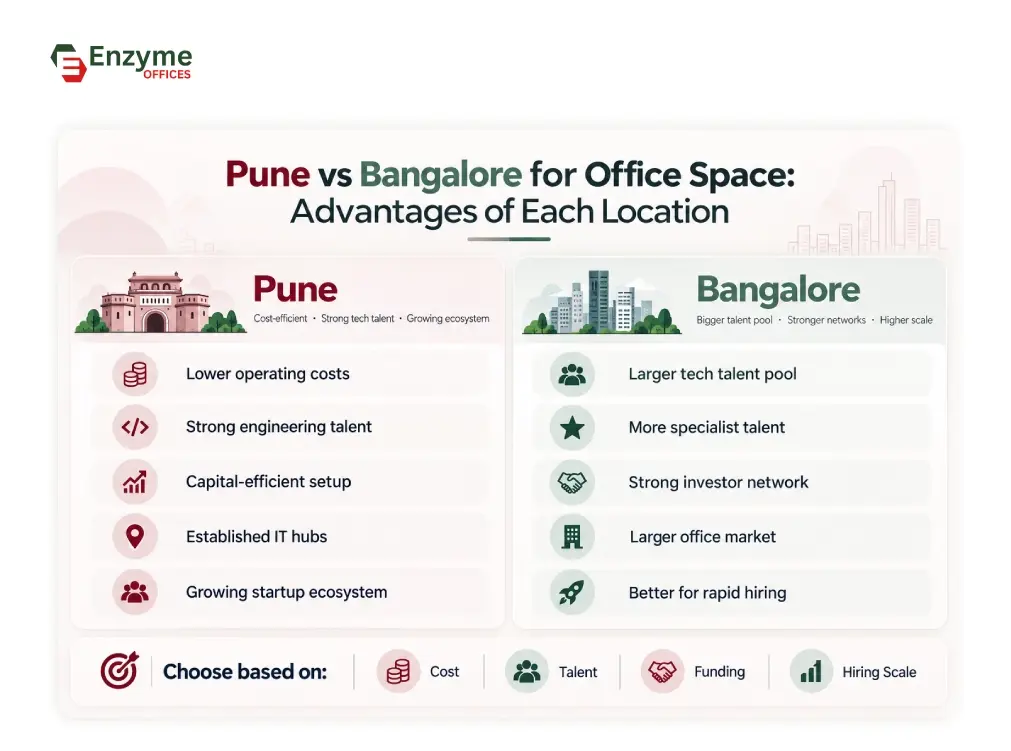
The better office location depends on more than the quoted rent. Companies comparing Pune and Bangalore should assess office costs, talent availability, Grade A supply, connectivity, business ecosystem, workspace flexibility, and future expansion together.
- Office rental costs
Pune can be a cost-effective option for businesses looking for office space, depending on the location and lease terms. Knight Frank’s H2 2025 report recorded average transacted office rents of ₹78 per sq. ft. per month in Pune and ₹97 in Bengaluru.
Hinjewadi, Kharadi, and Baner-Balewadi in Pune offer different options, as do Electronic City, Whitefield, and ORR in Bangalore. Compare rent alongside maintenance, parking, fit-out, utilities, deposits, and lease terms to estimate the total occupancy cost.
- Talent availability
Bangalore has a larger technology talent pool, especially for software, AI, product, and specialist technology roles. Pune has a strong workforce across engineering, IT, automotive, manufacturing, BFSI, and GCCs.
The better fit depends on the roles your company needs to hire and the availability of suitable professionals in each location.
- Grade A office supply and availability
Bangalore has a significantly larger Grade A office market. Its Grade A office stock stood at 244.3 million sq. ft. in Q2 2026, compared with 81.5 million sq. ft. in Pune.
This larger market gives Bangalore a wider range of office locations and building formats. Pune’s smaller market still offers substantial Grade A supply across Kharadi, Hinjewadi, Baner-Balewadi, Viman Nagar, and other established corridors.
- Connectivity and employee commute
Both cities have multiple business corridors, so commute times depend on the office location and where employees live. Bangalore’s key hubs include ORR, Whitefield, Electronic City, and North Bangalore; Pune’s include Kharadi, Hinjewadi, Baner-Balewadi, and Hadapsar.
- Startup and business ecosystem
Bangalore has a larger technology and startup ecosystem, making it a strong option for businesses that rely on specialist tech hiring, investors, and technology partnerships. Pune has a diversified base across IT, engineering, automotive, manufacturing, BFSI, and GCCs.
The best city for a startup depends on its business model, hiring needs, customer base, and operating budget.
- Workspace flexibility and scalability
Both cities offer traditional offices, coworking spaces, and managed workspaces. Compare options based on current seat requirements, expansion capacity, meeting rooms, parking, IT infrastructure, fit-out needs, and lease flexibility.
Managed offices can help growing companies move in faster and reduce the upfront work involved in setting up and maintaining a workspace.
Office rent Pune vs Bangalore: Which is more affordable for office space?
Pune is generally more affordable for office space than Bangalore. In Q2 2026, the average quoted Grade A office rent was ₹87.6 per sq. ft. per month in Pune, compared with ₹102.1 in Bangalore, according to Colliers.
However, actual costs vary by micro-market, building grade, office size, lease terms and additional charges such as maintenance and parking.
Pune office rent by micro-market
Pune’s office market has substantial variation between established central locations and peripheral technology corridors.
| Pune micro-market | Q2 2026 quoted rent (₹/sq. ft./month) |
| CBD | 109.7 |
| Kharadi | 93.8 |
| Baner-Balewadi | 93.6 |
| Viman Nagar | 93.3 |
| Hadapsar | 86.3 |
| Wakad | 85.0 |
| Hinjewadi | 61.0 |
| PCMC | 62.1 |
| Pune average | 87.6 |
These figures are Colliers’ weighted average quoted rents for warm-shell Grade A offices and exclude CAM and taxes.
What should be included in the total office cost?
Monthly rent is only one part of the office budget. Companies should compare:
- Base rent
- CAM and maintenance charges
- Security deposit
- Fit-out and furniture
- Utilities and internet
- Parking
- Facility management
- Lease and lock-in conditions
- Restoration obligations
- Additional space required during expansion
A traditional lease can require significant upfront spending before the team occupies the office. Managed offices can integrate workspace, furniture, facilities, and operational support into one setup, which can reduce the initial setup burden.
Pune or Bangalore: Which city fits your business?
Pune suits businesses prioritizing lower office rents and engineering talent, while Bangalore is a strong choice for specialist technology hiring, startup networks, and large-scale office expansion.
Your choice depends on your team’s priorities, hiring plans, and budget. Use the comparison below to identify which city aligns better with your business needs.
| If your priority is… | Consider | Why |
| Lower average Grade A rent | Pune | Lower Q2 2026 citywide average quoted rent |
| Specialist technology hiring | Bangalore | Deeper technology-focused talent ecosystem |
| Engineering and technical teams | Both | Strong engineering talent bases |
| Automotive/manufacturing ecosystem | Pune | Established industrial and engineering base |
| Startup and investor ecosystem | Bangalore | Larger concentration of startups, investors and technology companies |
| Large-scale office expansion | Bangalore | Larger Grade A office stock and leasing market |
| Cost-conscious expansion | Pune | Lower citywide average office rent |
| Flexible workspace | Both | Established and growing flex markets |
| Airport-oriented location | Depends on hub | Compare Viman Nagar in Pune with relevant North/East Bangalore locations |
| Employee commute | Depends on workforce | Residential catchments vary significantly by micro-market |
The decision should ultimately come down to the specific office location and business requirements.

Final takeaway
Pune and Bangalore can both work for a growing team. The right choice depends on the roles you need to hire, where employees live, your 12–24 month headcount plan, and the total cost of occupying the office.
Compare the actual micro-markets before deciding. Enzyme provides affordable managed office solutions for businesses that need ready-to-use workplaces with flexibility around team size and expansion.
If you are comparing Pune office space, share your team size, location, workspace needs, and growth plans with Enzyme to find the right setup.
Contact Enzyme Offices to discuss your office requirements.
Frequently asked questions