

Pune offers several commercial locations for businesses looking to rent office space, but each area has different rental costs, connectivity, and workspace options. Choosing the wrong location can affect employee commutes, operating expenses, and scalability.
Areas such as Baner, Viman Nagar, Kharadi, and Hinjewadi offer different advantages depending on your business requirements, team size, and budget.
In this guide, we compare Pune’s key commercial areas, explore furnished, managed, and customized office spaces, and explain the rental costs and lease terms to consider before making a decision.
TL;DR – A Quick summary
- Pune’s key office locations serve different needs: Baner–Balewadi suits startups and technology companies, Hinjewadi and Kharadi suit large IT teams, and Viman Nagar suits client-facing businesses.
- Coworking, managed offices and traditional leases are major office types in Pune that differ in privacy, setup costs, move-in time and operational responsibilities.
- Compare total occupancy costs, including rent, maintenance, utilities, fit-outs and taxes, rather than relying on base only on rent.
Table of Contents
What are the top areas for office on rent in Pune?
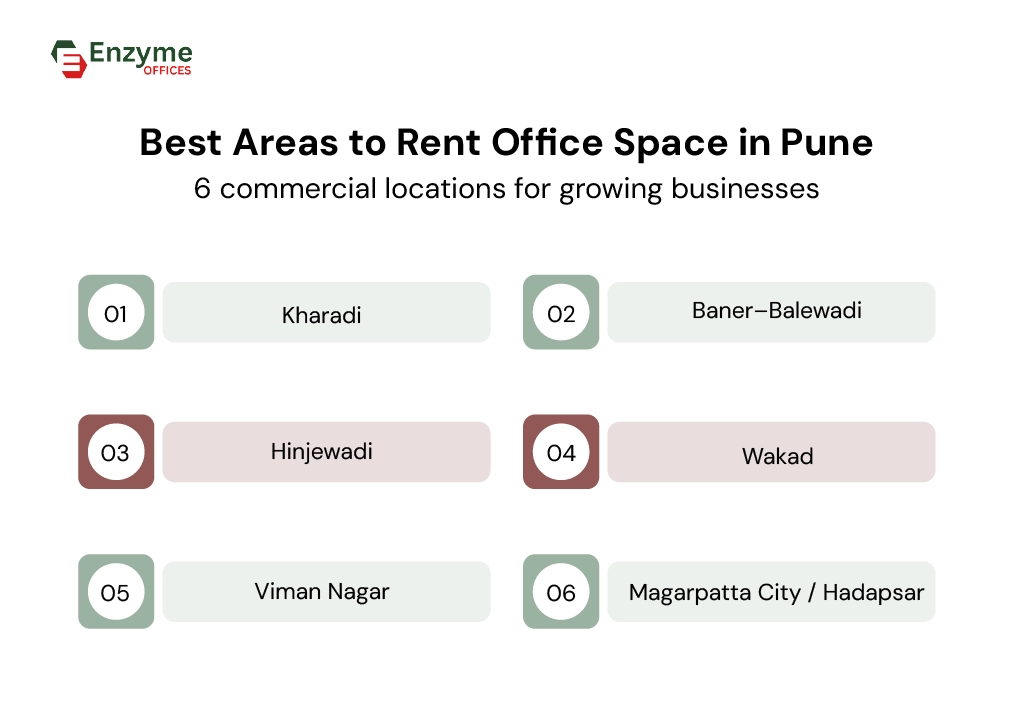
The best areas to rent office on rent in Pune for growing businesses are Baner-Balewadi, Hinjewadi, Wakad, Kharadi, Viman Nagar and Magarpatta City/Hadapsar.
| Area | Best for | Connectivity |
| Viman Nagar | Consulting and client-facing firms | Airport, Kalyani Nagar, Koregaon Park |
| Baner–Balewadi | Startups and SaaS teams | Aundh, Wakad, Hinjewadi, Expressway |
| Hinjewadi | Large IT teams | IT parks, Metro Line 3 corridor |
| Wakad | Teams near Hinjewadi and Baner | Hinjewadi, Baner, Expressway |
| Kharadi | IT and GCC teams | EON IT Park, WTC, airport access |
| Magarpatta City/Hadapsar | Mid-size teams | Camp, Kharadi, airport |
- Viman Nagar: Best for client-facing Firms
Viman Nagar is a good option for consulting, advisory, and service firms that frequently receive clients from outside Pune. Its proximity to Pune International Airport makes travel convenient for visiting clients. Nearby Viman Nagar and Koregaon Park also offer hotels and restaurants for client meetings and business stays.
- Baner–Balewadi: Best for startups and technology companies
Baner–Balewadi is a suitable location for startups and growing technology companies that want to stay close to Pune’s established IT ecosystem. Its proximity to Hinjewadi gives businesses access to the area’s technology workforce and established IT companies.
- Hinjewadi: Best for Large IT teams
Hinjewadi is suitable for large IT teams because it has several technology parks and commercial office developments. Metro Line 3 is planned to connect Hinjewadi with Shivajinagar via Balewadi, providing public transport connectivity once operational.
Many large office campuses have controlled entry and on-site security, which can support teams working late shifts. However, peak-hour traffic can affect employee commutes, and travelling to client offices in central Pune may take longer.
- Kharadi: Best for large IT and GCC teams
Kharadi has an established commercial ecosystem for IT and GCC companies. EON IT Park and World Trade Center house several technology and financial services companies, making the area a recognised business destination. The Pune–Ahmednagar Highway also connects Kharadi with Viman Nagar, Hadapsar and Pune International Airport.
- Wakad: Best for teams that need easy access to Mumbai and West Pune
Wakad is worth considering for teams that need access to Hinjewadi, Baner and Balewadi. It is well-connected to the Mumbai–Pune Expressway, making it easier for businesses that need easy connectivity to Mumbai.
- Magarpatta City/Hadapsar: Best for businesses looking for an integrated office township
Businesses that prefer an integrated office environment can consider Magarpatta City. Its Cybercity development houses major technology and financial services companies, including Accenture, Capgemini, BNY Mellon and Deutsche Bank. The township also has restaurants, retail outlets and healthcare facilities, giving employees access to everyday amenities close to their workplace.
Which type of office space is available in key business districts of Pune?
Pune has three major types of office space: coworking spaces, managed offices and traditional long-term leases. The right option depends on headcount, privacy, occupancy time, budget, and flexibility.
- Coworking space
Coworking spaces in Pune offer ready-to-use facilities, reducing the time required to move in. They provide shared work areas and common facilities used by people from different businesses.
If you need a small office for rent in Pune for 3–10 people, coworking space can be suitable for you.
- Managed office space
Managed office space in Pune gives your business a dedicated suite or floor, while the provider handles day-to-day facilities management. Depending on your requirements, you can customise the space to suit your team. Most managed offices include furniture, workstations, internet, power backup, air conditioning, housekeeping, security and 24/7 access.
Managed offices require minimal upfront investment, allow businesses to move in quickly and offer more flexible rental options than traditional long-term leases.
- Long-term lease
Traditional long-term leases give businesses greater control over office layout, design and branding. However, you need to pay higher upfront costs for security deposits, interiors, furniture and fit-outs. Setting up the office also takes longer, as you have to manage design, construction, approvals and facility arrangements before moving in. A traditional lease is suitable for companies with a stable headcount, a defined workspace plan and the budget to manage the initial setup.
| Office type | Move-in time | Layout control | Best for |
| Coworking space | Immediate | Low | Early teams testing a location |
| Managed | Usually within a few days depending on provider | Medium | Scaling teams that want operations handled |
| Traditional lease | Slower, depends on fit-out | High | Established teams with fixed layout and brand needs |
What affects the cost of commercial office space for rent in Pune?
Office space rent in Pune depends on the location, building quality, office format, number of seats, lease duration and services included. To compare options accurately, calculate the full monthly occupancy cost, including maintenance, utilities, parking, furniture, fit-out expenses and applicable taxes.
- Location and building grade
Rent varies by location and building quality. Grade A offices in high-demand business districts may cost more than offices in older buildings or less central areas. Check whether the higher rent is justified by better connectivity, security, facilities and client access.
- Lease term, lock-in and flexibility
A longer lock-in period may come with a lower monthly rent, but it limits your ability to relocate. Shorter lease commitments offer more flexibility and may cost more. Check the lock-in period, notice period, rent escalation clause and security deposit before signing.
What is included in the rent?
Two office rental quotes may cover different services and facilities. No grammatical correction needed. Check whether furniture, internet, power backup, air conditioning, housekeeping, security, parking and meeting room access are covered by the rent or charged separately.
Total monthly cost formula
Use this formula to compare recurring monthly expenses:
Monthly occupancy cost = Base rent + Maintenance + Electricity and power backup + Parking + Internet and other service charges + Applicable taxes
Also account for one-time expenses such as furniture, fit-outs, deposits, brokerage and setup fees, where these are not included in the rental agreement.
Suggested Reading: Office on Rent in Baner: Rates, Lease Terms & Checklist
How to choose and shortlist the right office space in Pune?
To choose the right office space in Pune, estimate your current and expected seating requirements, map employee commutes and client locations, compare areas and office formats, and review total costs and lease terms. Visit shortlisted offices before confirming availability, inclusions and exit conditions in writing.
Five-step shortlisting process
- Estimate your current seating requirements and expected team size over the next 12 months.
- Map where your employees live and where your clients are based.
- Shortlist two or three areas from the location comparison table.
- Request quotes using the same seat count and list of required facilities.
- Visit each office during peak commute hours and confirm the lease terms in writing.
Quick checklist
- Building security, access control, CCTV and late-hour access
- Internet reliability and power backup
- Parking availability and public transport access
- Nearby restaurants, healthcare facilities and banks
- Availability of additional seats as your team grows
- Services included in the rent and any additional charges
- Lock-in period, notice period and exit conditions
- Permission to use the office address for GST or company registration, confirmed with your CA

Final takeaway
Before renting an office, estimate how many seats your business will need over the next 12–18 months. Compare locations, monthly occupancy costs and lease flexibility against that estimate. This can help you avoid paying for unused space or signing a lease that cannot accommodate your hiring plans.
Also, consider who will manage daily office operations. If your team does not have the time or resources to handle maintenance, housekeeping and facilities, a managed office may be a suitable option.
Contact Enzyme to discuss office options in Baner and Viman Nagar based on your team’s space and facility requirements.
Frequently asked questions
1. Which is the best area to rent office space in Pune for a growing business?
Kharadi and Hinjewadi are suitable for large IT teams, while Baner–Balewadi are good for startups and growing technology companies. Viman Nagar suits client-facing businesses, Wakad offers west Pune access, and Magarpatta City/Hadapsar suits mid-sized teams. Choose based on employee commutes, client locations, and expansion plans.
2. How do I find office space for rent in Pune near my team’s homes?
Start by mapping where your employees live and identifying areas that minimise average commute times. Shortlist two or three locations, then test travel times during peak hours. Compare public transport, metro connectivity, parking, and shuttle services before selecting an office.
3. Is managed office space in Pune better than traditional rental options?
Managed office space in Pune can be a better option for businesses that want a ready-to-use workspace, minimal upfront investment and fewer day-to-day facility management responsibilities. The provider typically handles furniture, internet, housekeeping, security and maintenance. Traditional office leases offer greater control over office layout, design and branding but require businesses to manage fit-outs, setup costs and ongoing operations.
4. What is the difference between coworking and managed office space in Pune?
Coworking spaces provide shared workspaces and common facilities for multiple businesses. Managed office space gives your company a dedicated private suite or floor, with services such as housekeeping, internet, and security handled by the provider. Choose based on privacy, control, and operational needs.
5. How much time does it take to rent a commercial office space in Pune?
Ready-to-use furnished and managed offices generally require less preparation than customised spaces. The actual timeline depends on availability, documentation, lease negotiations, and required modifications. Ask providers for a confirmed move-in date and clarify any setup requirements before signing the agreement.
6. Can I increase or reduce the number of seats in a rented Pune office?
Yes, if your agreement allows changes to your workspace capacity. Before signing, check whether the provider permits additional seats, downsizing, or relocation within the building. Confirm pricing adjustments, notice periods, and minimum commitments to accommodate changing headcount without unexpected expenses.